





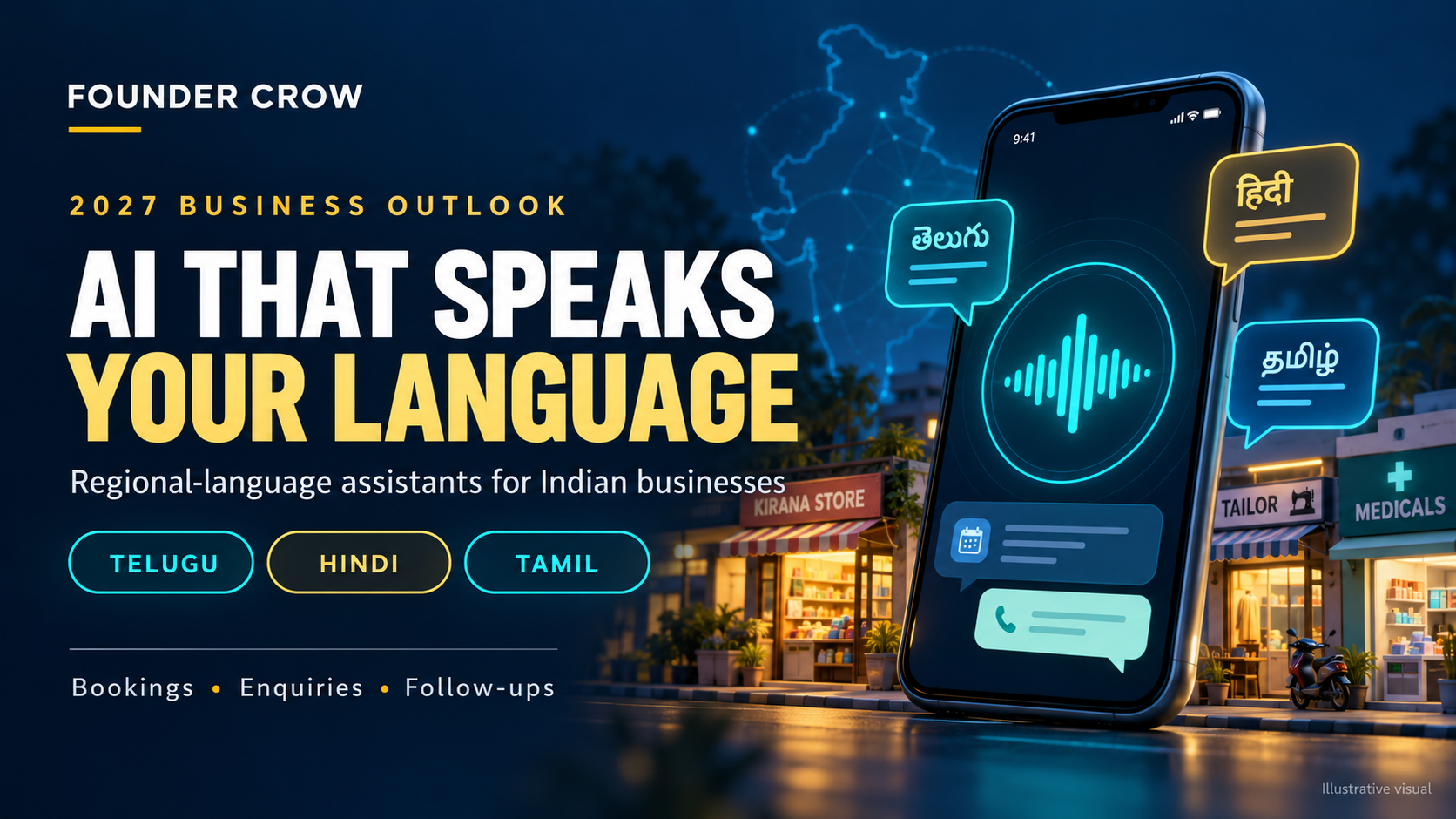
News Analysis — 2027 Business Outlook
Hunar.AI’s ₹40 crore funding round puts attention on conversational AI for Indian workplaces. For aspiring entrepreneurs, it also raises a broader opportunity: developing regional-language assistants that help businesses manage enquiries, appointments and follow-ups. Success will depend on reliable service, measurable customer value and careful cost management.
A customer calls a local business, asks a question in Telugu and expects a clear answer. Another sends a Hindi voice message to confirm an appointment. A third wants to know—in Tamil—whether a service is available in their neighbourhood.
These everyday interactions offer a practical starting point for entrepreneurs exploring artificial intelligence. As founders plan for 2027, one business idea worth testing is an AI assistant that understands a particular industry and communicates in the languages its customers use.
Recent investment in India’s conversational AI sector provides a relevant example. On October 19, 2026, Hunar.AI announced a ₹40 crore Series A round led by Blume Ventures, taking its total funding to ₹65 crore. The company plans to invest in AI infrastructure, product development and market expansion. Founded in 2022 by Krishna Khandelwal and Shantanu Bhattacharyya, it focuses on frontline workforce operations.
Hunar.AI’s products support interactions with candidates and employees through voice calls, WhatsApp and chat. Its website describes applications including screening, interview scheduling and onboarding, with support for more than 20 languages and dialects. These are company-described capabilities rather than an independent assessment of performance.
The broader opportunity explored here is an extension of that business approach: applying focused, multilingual assistance to other everyday commercial tasks. It is a potential direction for new founders, not an announced Hunar.AI expansion plan.
A useful starting point: one industry, one recurring problem
Consider a hypothetical vehicle-service centre in Vijayawada. Staff may repeatedly answer questions about opening hours, service availability, booking slots and collection arrangements. A Telugu-speaking assistant connected to accurate business information could handle routine enquiries and pass unusual requests to an employee.
A similar approach could serve a training institute handling course enquiries or a home-maintenance company arranging visits. Each business has different requirements, however. An assistant should only confirm information or take actions that its connected systems can reliably support.
For a new startup, choosing one industry makes the first product easier to build and assess. The founder can learn the vocabulary, common questions and exceptions before expanding to more customers.
Speaking a language is only part of the product
A convincing voice demonstration does not establish that a system is ready for daily business use.
Customers may mix Telugu and English, change their request halfway through a sentence or call from a noisy location. A reliable assistant must handle uncertainty without inventing prices, promising unavailable services or confirming appointments that do not exist.
Founders should test realistic conversations with speakers from their intended market. The assistant should identify itself as automated, allow corrections and offer a straightforward route to human help.
Business information also needs regular maintenance. Updated prices, holiday schedules and service boundaries can matter as much as the underlying AI model.
How the business could earn revenue
A possible commercial model combines an initial setup fee, a monthly service charge and usage-based billing.
The setup fee could cover organising business information, preparing conversation flows and connecting booking or customer-management systems. A monthly charge could cover monitoring, reporting, updates and support. Usage charges could account for call minutes or message volumes.
These are proposed pricing approaches, not confirmed market rates or Hunar.AI’s pricing.
Profit would depend on what remains after paying for speech processing, AI services, telephony, messaging, hosting, customer support and sales. A customer who pays a substantial subscription can still be unprofitable if their account requires extensive manual intervention.
Measure completed work, not just conversations
Before investing heavily, a founder could run a limited paid pilot with a small number of businesses in the same sector.
Useful measures would include successful bookings, correctly answered enquiries, human handovers, customer complaints and the cost of completing each task. For the business owner, the value might come from fewer missed enquiries, less repetitive staff work or better appointment attendance.
The strongest evidence would be customers renewing after seeing a clear benefit. A large number of automated calls, by itself, would not demonstrate that the product works commercially.
What entrepreneurs and investors should examine for 2027
Regional-language AI could create opportunities for founders who combine technical capability with a detailed understanding of local business operations. Existing technology may provide the foundation, while industry-specific integrations, customer relationships and reliable support provide differentiation.
Investors should examine whether customers continue paying, how much human work each account requires and whether revenue covers the full cost of delivery. Founders should also establish appropriate permission and data-handling practices for customer communications.
Hunar.AI’s funding is evidence of investor interest in a particular company and use case. It does not guarantee demand or profits for every conversational AI venture.
For a new Indian startup, the most credible first milestone is smaller and more concrete: help one type of business complete one important task reliably, in its customers’ language, at a cost they are willing to pay.